
10 Benefits of Gymnastics for Kids:That Go Way Beyond the Gym

Gymnastics isn't just about cartwheels and back handsprings. The benefits of gymnastics for kids reach into every corner of childhood — physical development, mental focus, emotional resilience, and the kind of confidence that shows up everywhere from the classroom to the soccer field.
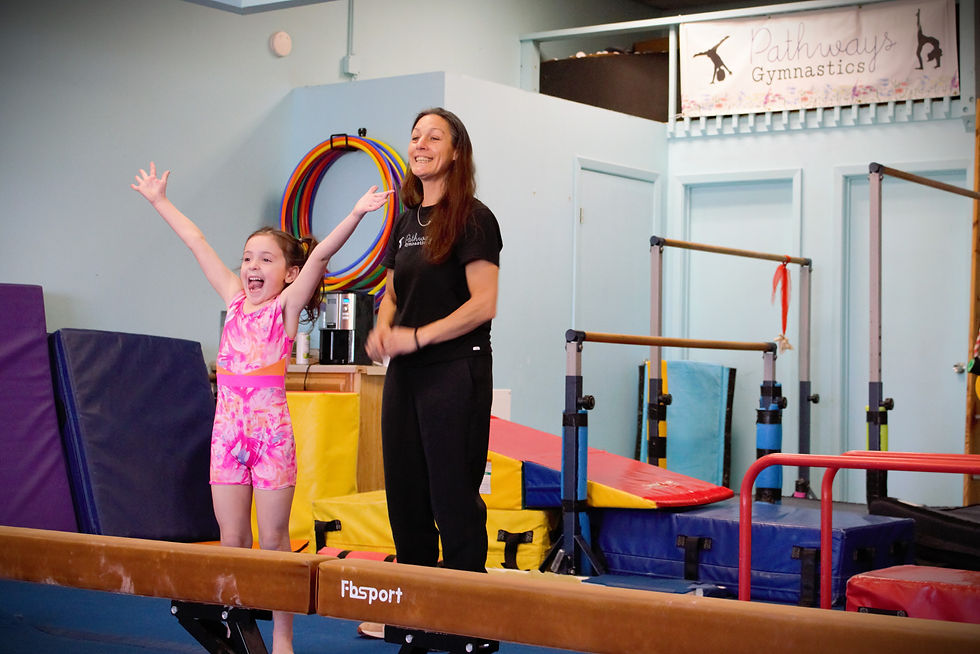
At Pathways Gymnastics in Bastrop, TX, we see it every single week. A child who couldn't let go of their parent's hand in September is bounding across the beam by December. A kid who thought they could never do a cartwheel runs home to show their family what they learned. A shy six-year-old finds her people and starts coming through the door every week with a huge smile.
The gymnastics is the vehicle. What it delivers is so much bigger. Here are the 10 benefits that Bastrop parents consistently tell us surprised them most — and the science behind why gymnastics delivers them better than almost any other activity.

What Are the Benefits of Gymnastics for Kids?
The benefits of gymnastics for kids include improved physical strength, flexibility, balance, and coordination, as well as mental benefits like focus, discipline, and resilience. Gymnastics also builds emotional confidence and social skills, and creates a physical foundation that helps children thrive in every other sport and activity.
Here's the full picture: the 10 benefits parents at Pathways talk about most, and what each one actually looks like in your child's daily life:
1. Full-Body Physical Strength
Gymnastics develops strength across the entire body — core, upper body, and legs — in a way that very few childhood activities match. Skills on bars build arm and shoulder strength. Vault and tumbling build leg power. Floor work and beam develop core stability that protects the spine and supports posture throughout childhood and beyond.
Unlike sports that develop one set of muscles predominantly, gymnastics trains everything — which is why gymnasts tend to be among the most physically capable athletes when they try other sports.
2. Flexibility That Protects for Life
Flexibility isn't just useful in gymnastics — it's a lifelong protective factor for joint health, injury prevention, and physical comfort. Children who develop flexibility young maintain that range of motion into adulthood more easily than those who start later.
At Pathways, flexibility is built progressively and safely through stretching, bridging, and skill work — never forced, always appropriate for each child's development.
3. Balance and Coordination
Balance beam is the most obvious balance builder — but coordination development happens in every corner of a gymnastics class. Learning to coordinate arms, legs, and core simultaneously during rolls, cartwheels, and handstands builds neural connections that transfer directly to sports, dance, everyday movement, and even handwriting.
Research Note: Studies show that children with strong balance and coordination skills demonstrate better academic performance, particularly in reading and math. Movement and brain development are more connected than most parents realize.
4. Bone Density and Long-Term Health
Gymnastics is a weight-bearing sport, which means it actively builds bone density during the years when children's bones are developing fastest. The American Academy of Pediatrics identifies weight-bearing physical activity in childhood as one of the most important factors in preventing osteoporosis and fractures later in life.
Children who participate in gymnastics during their early years are investing in skeletal health that pays dividends for decades.
5. Genuine, Deep Confidence
This is the benefit Bastrop parents mention most — and it's the one that surprises them most. Gymnastics builds a specific kind of confidence: the kind that comes from doing something you genuinely thought you couldn't do.
Every gymnastics skill — from a forward roll to a cartwheel to a back walkover — felt impossible before it happened. The moment a child achieves it, something shifts. They learn, in their body, that hard things become possible. That belief doesn't stay in the gym. It walks into classrooms, onto playgrounds, and into every new challenge they face.
Parent Story: We hear this constantly: 'I don't know what you did, but she's so much more willing to try new things now.' That's the confidence effect — and it's real.
6. Focus, Discipline, and the Ability to Learn
A gymnastics class requires children to pay attention, remember sequences, follow multi-step directions, and persist through repetition. These are exactly the skills demanded in a classroom — and the practice transfers.
Teachers consistently report that students who participate in gymnastics demonstrate stronger attention spans and willingness to try challenging tasks. The discipline of working toward a skill over multiple classes — without giving up — is a lesson in growth mindset that no worksheet can replicate.
7. Resilience — Learning to Fall and Get Back Up
Every gymnast falls. Not occasionally — regularly. And what happens next is one of the most powerful developmental experiences in childhood: they get back up, reset, and try again.
In a world where children are increasingly protected from failure, gymnastics offers a safe, supervised environment where falling is expected, normalized, and part of the process. The emotional muscle of resilience — getting up after something is hard — is built one fall at a time, in a place where coaches celebrate the effort, not just the outcome.
8. Social Connection and Teamwork
Gymnastics looks like an individual sport from the outside, but inside the gym it's deeply social. Children cheer each other on. They celebrate each other's victories. They share the experience of working toward something hard together.
At Pathways, our class structure intentionally builds social connection — through partner activities, group challenges, and the simple rhythm of rotating stations together week after week. Many of the strongest friendships our families form in Bastrop started right here on the mat.
9. A Foundation That Makes Every Other Sport Better
This is the benefit that parents of multi-sport kids notice most clearly. Children who have a gymnastics background are more coordinated, more body-aware, and more coachable when they enter other sports. Soccer coaches notice it. Baseball coaches notice it. Dance teachers notice it.
The body control, spatial awareness, and physical confidence built in gymnastics are prerequisites for athletic excellence in almost every other activity. Starting with gymnastics doesn't limit your child's options — it expands them.
10. A Healthy Relationship with Movement
Perhaps the most underrated benefit of all: children who have positive early experiences with movement grow up loving physical activity. They associate exercise with fun, achievement, and friendship — not obligation.
In a world where childhood sedentary time is at an all-time high, giving your child an activity they genuinely love and look forward to is one of the most important investments you can make in their long-term health.
Benefits of Gymnastics for Kids at a Glance
Here's a quick summary of what gymnastics builds and how — useful for sharing with partners, grandparents, or anyone wondering why you chose gymnastics:
Benefit | What It Looks Like | How Gymnastics Builds It |
Physical Strength | Core, upper body, and leg strength that supports posture and everyday movement | Weight-bearing skills on bars, vault, and floor develop full-body strength from an early age |
Flexibility | Range of motion that protects joints and reduces injury risk in all activities | Stretching, bridging, and skill progressions gradually increase flexibility safely over time |
Coordination | Smooth, controlled movement of multiple body parts at once | Gymnastics requires constant coordination of arms, legs, and core — every skill builds this |
Balance | Ability to control the body in static and dynamic positions | Beam work and floor skills build both static and dynamic balance more directly than almost any sport |
Confidence | Willingness to try hard things and belief in one's own ability | Mastering skills that once felt impossible creates a unique, deep confidence that carries into life |
Focus & Discipline | Ability to concentrate, follow directions, and persist through challenges | Gymnastics requires attention to detail and repetition — skills that directly support classroom learning |
Resilience | Ability to get back up after falling or failing | Every gymnast falls. Learning to reset and try again teaches resilience better than almost anything else |
Social Skills | Comfort with peers, turn-taking, encouragement, and teamwork | Group classes and shared challenges naturally build friendships and social confidence |
Does Gymnastics Help Kids With Confidence?
Yes — gymnastics is one of the most effective confidence-building activities for children. Each skill mastered was once something that felt impossible, creating a deep, earned confidence that carries beyond the gym. Parents consistently report their children become more willing to try new things, handle challenges better, and believe in themselves more after starting gymnastics.
Of all the benefits parents tell us they notice, confidence is the one that comes up most — and it's the one that tends to show up fastest.
It makes sense when you think about it. Gymnastics presents children with clear, concrete challenges. You either can do a cartwheel or you can't — yet. The moment you can, that achievement is undeniable. It happened in your body. Nobody gave it to you. You earned it.
That process — struggling, practicing, achieving — repeats itself dozens of times in every gymnast's experience. Over months and years, it builds a quiet, deep confidence that isn't dependent on praise or external validation. It comes from the inside. And it shows up everywhere.
What Bastrop Parents Tell Us: The phrase we hear most often from parents — usually around month three or four — is some version of 'I don't know what changed, but she just seems more confident.' We know what changed. And we see it every week.
Is Gymnastics Good for Kids' Brain Development?
Yes. Gymnastics supports brain development by building neural pathways through complex movement patterns, improving spatial awareness and memory, and developing focus and attention span. Research from institutions including the CDC and Harvard's Center on the Developing Child links structured physical movement in early childhood to stronger cognitive development and academic readiness.

The name Pathways Gymnastics isn't random. We chose it because we believe in what the science shows: movement opens brain pathways. Physical learning and cognitive learning are deeply connected, especially in the early childhood years.
When a child learns a forward roll, they're not just learning a gymnastics skill. They're learning to organize their body in space, sequence movements in the right order, receive feedback from their body and adjust — all of which are cognitive processes. The same neural pathways that process these physical experiences are involved in reading, math, and problem-solving.
This is why children who participate in gymnastics and structured movement programs consistently show stronger focus, better spatial reasoning, and improved academic performance compared to sedentary peers.
What Age Should Kids Start Gymnastics to Get the Most Benefits?
Children can start benefiting from gymnastics as young as birth through parent-child movement classes. The most impactful developmental window is ages 2–6, when gross motor skills are developing rapidly. However, children who start at any age — including 7, 8, or older — experience significant benefits from gymnastics. Earlier is better, but it's never too late to start.
The short answer: the earlier the better — but any age is a good age.
The 2–6 window is especially powerful because children's brains and bodies are in a peak phase of motor development. The physical experiences they have during this period lay down neural pathways that support movement, learning, and physical confidence for the rest of their lives.
That said, we've seen children start at 8, 9, even 10 and experience every single benefit on this list. The confidence boost doesn't care how old you are when you finally nail that cartwheel. The resilience built by falling and getting back up works the same way at 7 as it does at 4.
At Pathways Gymnastics in Bastrop, we offer age-appropriate classes from birth through 16 — so whenever your child is ready, there's a perfect starting point waiting for them.
Ready to See the Benefits for Yourself? Come watch a class, tour the gym, or jump straight into summer camp. There's no better way to understand what gymnastics does for a child than watching it happen in real time.
Give Your Child Every Advantage: Start at Pathways Gymnastics in Bastrop TX
The benefits of gymnastics for kids are real, they're research-backed, and they're available to every child in Bastrop right now — regardless of age, experience level, or athletic background.
At Pathways Gymnastics, we offer year-round classes for children from birth through 16, summer camps, specialty programs, and classes designed for children with sensory and developmental differences. Whatever your child needs, we have a place for them.
Enroll today at pathwaysgymnastics.com or call 512-829-3547 (512-829-FLIP).

Comments