
Gymnastics vs Other Sports for Kids:Why Gymnastics Makes the Best First Sport

Every parent of a young child eventually faces the question: which sport should my child start first?
Soccer is everywhere. Dance studios fill up fast. Swimming feels practical. And gymnastics — well, gymnastics is the one you're reading about right now, which means something already caught your attention.
When it comes to gymnastics vs other sports for kids, the honest answer isn't that every other sport is wrong. It's that gymnastics builds something the others can't quite replicate — a physical and mental foundation that makes children better at everything they try next.
Here's the breakdown parents in Bastrop are asking for — sport by sport, benefit by benefit — so you can make the most informed decision for your child.
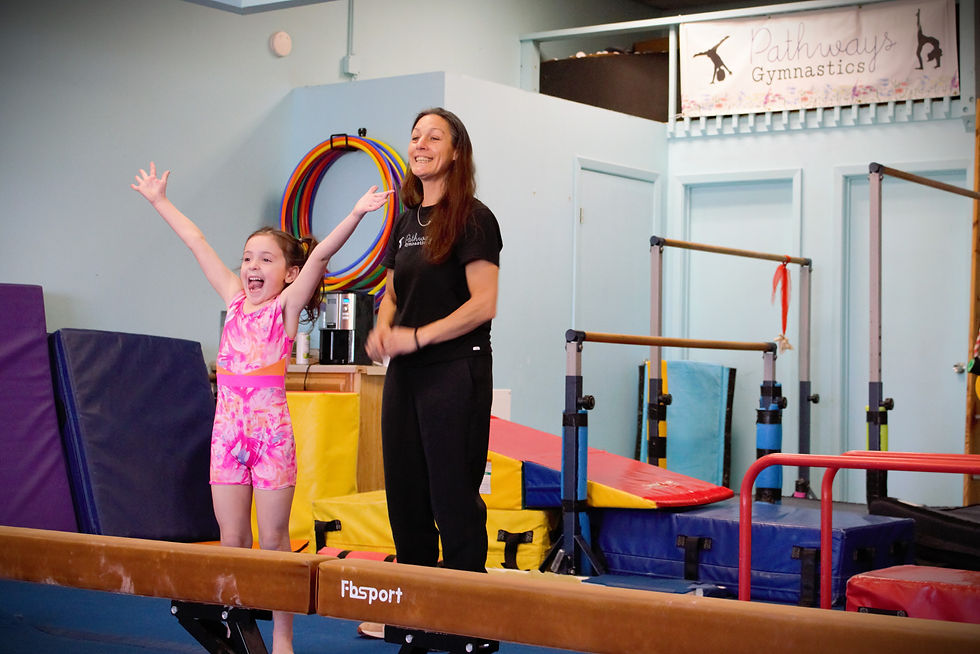
Is Gymnastics the Best Sport for Young Kids?
🔍 Is gymnastics good for kids as a first sport?
Yes. Gymnastics is widely considered the best foundation sport for young children because it develops balance, coordination, strength, flexibility, spatial awareness, and body control simultaneously — skills that directly transfer to every other sport. Most elite athletes across multiple sports have a gymnastics or movement background.
The reason gymnastics earns the title of 'foundation sport' isn't marketing — it's anatomy and neuroscience. Young children between the ages of 2 and 8 are in a critical window for developing gross motor skills. The more varied, controlled, and deliberate the movements they practice during this window, the stronger the neural connections they build for physical learning.
Gymnastics, by design, covers more of that ground than any other single sport. A child who spends two years in gymnastics before picking up soccer, basketball, or dance arrives with body awareness, coordination, and proprioception that their peers who skipped that foundation simply don't have yet.
Research Note: Studies published by the American Academy of Pediatrics consistently show that children who participate in multi-movement sports early develop better long-term athletic ability and are less prone to overuse injuries than early sport specialists.
Gymnastics vs Soccer, Dance, and Swimming: Side-by-Side
Here's how gymnastics compares to the most popular kids' sports across the skills that matter most for early childhood development:
Skill Built | Gymnastics | Soccer | Dance | Swimming |
Full-body strength | ✅ Excellent | ⚡ Good | ⚡ Good | ✅ Excellent |
Balance & coordination | ✅ Excellent | ⚡ Good | ✅ Excellent | ⚡ Good |
Flexibility | ✅ Excellent | ❌ Minimal | ✅ Excellent | ⚡ Good |
Spatial awareness | ✅ Excellent | ⚡ Good | ⚡ Good | ⚡ Good |
Confidence & independence | ✅ Excellent | ⚡ Good | ⚡ Good | ⚡ Good |
Focus & discipline | ✅ Excellent | ⚡ Good | ✅ Excellent | ✅ Excellent |
Starting age | Birth+ | 3–4 years | 2–3 years | 6 months+ |
Team or individual | Both | Team | Both | Both |
Foundation for other sports | ✅ Best | Limited | Limited | Good |
No sport does everything. But gymnastics covers more developmental ground in a single class than any sport in the table above — and starts earlier than almost all of them.
Gymnastics vs Soccer for Kids: What's the Real Difference?
🔍 Should my child start with gymnastics or soccer?
For children under 6, gymnastics is typically the better starting point. It develops individual body control, balance, and coordination that make children better at soccer (and all team sports) later. Soccer at very young ages is mostly unstructured play — gymnastics provides focused skill-building during the most critical developmental window.
Soccer is the most popular kids' sport in the US, and for good reason — it's social, accessible, and genuinely fun. But if you've ever watched a game of under-5 soccer, you know that it's mostly kids running in a pack chasing a ball with minimal structure.
That's not a criticism. It's developmentally appropriate. Young children aren't ready for team strategy. What they are ready for is learning what their own body can do.
That's where gymnastics has the edge. Every gymnastics class is focused on the individual child: their balance, their coordination, their confidence, their relationship to movement. The skills built in gymnastics — especially core strength, spatial awareness, and landing mechanics — directly translate into making a better soccer player later.
Coach Perspective: The kids who come to us after a few years of gymnastics and want to try soccer are noticeably more coordinated, better at stopping and changing direction, and less likely to get hurt. The foundation is real.
Gymnastics vs Dance for Kids: Which One Builds More?
🔍Is gymnastics or dance better for kids?
Both gymnastics and dance are excellent for children. Gymnastics builds more overall body strength, spatial awareness, and fearlessness with movement. Dance builds musicality, rhythm, and creative expression. Many families choose gymnastics first for its broader physical foundation, then add dance later — or enroll in programs like acrobatic dance that combine both.
Gymnastics and dance share a lot of DNA — both require body awareness, flexibility, rhythm, and performance. But they develop children differently in key ways.
Gymnastics tends to build raw physical confidence. There's something uniquely powerful about a child who learns to do a handstand, a cartwheel, or a back walkover — the confidence that comes from literally conquering gravity doesn't happen the same way in other activities.
Dance tends to build artistic expression and musicality — equally valuable, just different. Many families do both, and they complement each other beautifully. If you have to choose one to start, gymnastics gives a slightly broader physical foundation that makes dance easier to pick up later.
For families interested in both, it's worth looking at acrobatic dance programs — and at Pathways, our acro and tumbling classes bring both worlds together in a way kids absolutely love.
Gymnastics vs Swimming for Kids: Is One Better?
🔍 Is gymnastics or swimming better for child development?
Both are excellent for child development and are often done together. Swimming builds cardiovascular endurance, full-body strength, and a vital safety skill. Gymnastics builds coordination, balance, body control, and confidence in movement on land. For most children, gymnastics is the better starting point for general athletic development; swimming is equally important for safety and overall fitness.
Swimming has one argument gymnastics doesn't: it's a safety skill. Knowing how to swim can save a child's life, and that's not something to minimize.
Beyond safety, though, both sports develop children in complementary ways. Swimming is excellent for cardiovascular fitness, full-body strength, and breath control. Gymnastics is superior for developing body awareness on land — balance, coordination, proprioception, and the kind of physical confidence that shows up in every other activity.
Many Bastrop families do both — and the good news is they don't compete with each other. In fact, children who do gymnastics tend to pick up swimming mechanics faster because they already understand how to control their bodies in space.
Family Tip: If you can only choose one activity right now, think about what your child needs most. Nervous in their own body? Start with gymnastics. Near water often without swim skills? Prioritize swimming. Both, when possible, is the answer.
Why Gymnastics First Makes Sense: The Foundation Sport Argument
Here's the case in plain terms: the skills gymnastics builds are prerequisites for almost every other sport.
Balance — needed in soccer, basketball, martial arts, skiing, surfing, dance
Coordination — needed in baseball, tennis, volleyball, hockey, swimming
Core strength — needed in literally every sport ever
Spatial awareness — needed in team sports, combat sports, racket sports
Body control and proprioception — needed in gymnastics, obviously, but also in preventing injuries across all sports
Fearlessness with physical challenge — the mental side that makes kids willing to try hard things
A child who spends ages 3–6 in gymnastics doesn't just learn gymnastics. They build the physical vocabulary to be good at nearly anything they try next. That's why so many elite athletes in other sports — from NFL players to NBA stars — cite gymnastics as part of their early training.
Does My Child Have to Choose Just One Sport?
🔍 Should kids do multiple sports or just one?
Research strongly supports multi-sport participation during childhood and early adolescence. Children who specialize in a single sport too early show higher burnout rates and more overuse injuries. Gymnastics pairs especially well with other sports because it develops transferable physical skills rather than sport-specific ones.
No — and in fact, the research strongly argues against early sport specialization. Children who play multiple sports develop more completely, stay in sports longer, and are less likely to experience burnout or injury.
Gymnastics is particularly good as a complement to other sports because the skills it builds are transferable, not specialized. A child doing gymnastics plus soccer isn't double-investing in sport-specific skills — they're building a foundation that makes them better at both.
At Pathways Gymnastics, many of our students also play soccer, take dance, swim competitively, or play baseball. We see the combination pay off constantly — in the gym and in the updates parents share when their child surprises their other coaches.

Give Your Child the Foundation That Lasts — Start at Pathways Gymnastics in Bastrop
Whether your child is curious about gymnastics for the first time or you're evaluating it alongside other sports, we'd love to talk it through with you. At Pathways Gymnastics in Bastrop, TX, we offer classes for every age starting from birth — and we've watched hundreds of kids build the physical confidence and coordination that sets them up for a lifetime of loving movement.
Come tour the gym, watch a class, and see what the foundation sport really looks like in action.
Enroll today at pathwaysgymnastics.com or call 512-829-3547 (512-829-FLIP).


Comments